
Learning Through Imagination, Collaboration, and Play
Image created by Samara Marin using Copilot 2024
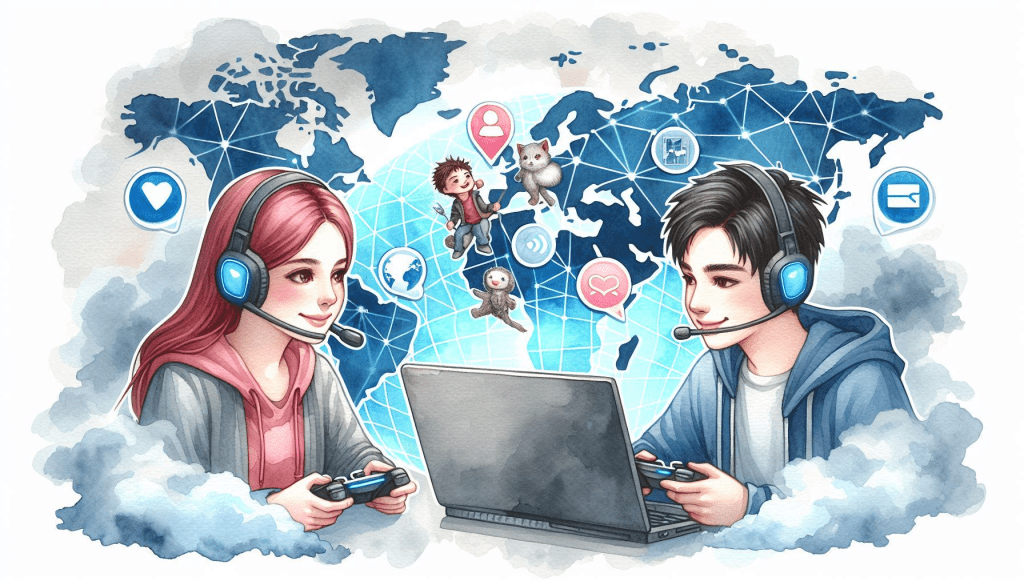
There have been times when reading a text book have been difficult to begin, difficult to get through, and difficult to finish. As an avid life-long gamer and current esports coach at my current position, it didn’t take long before A New Culture of Learning: Cultivating Imagination for a World of Constant Change peaked my interest. On page seven not only does the book reference the why game, which my seven, three, and two year old all currently play, but Thomas and Brown also reference online games which is how I was able to get the esports team at my current district started through remote gaming.
As I consumed the pages of information, I was intrigued by the proposals that the pages offered. As the esports coach, I have seen how games have promoted collaboration and problem-solving skills amongst my team; however, I have a new challenge: how can I incorporate these concepts into a classroom? Thomas and Brown (2012) offer two elements to ensure the new culture of learning is successful in the school: ” a massive information network that provides almost unlimited access and resources to learn about anything” and “a bounded and structured environment that allows for unlimited agency to build and experiment with things within those boundaries.” (p. 8)
“Inquiry is an extremely powerful technique for learning because it produces stockpiles of experiences. “
(Thomas, Brown, 2012 p. 67)
Out of all of the ideas in the book, this idea is the one that stuck out the most. Most children and adults want to know why something is happening, and most students don’t like to do something simply because they are told to do it. One of the main reasons that I became an educator is because I love to learn. An educator who pursued a career to learn seems like a paradox to many; however, every year, I get a new set of minds who see the same curriculum in a different light. Therefore, I have different questions sent my way every year, and I don’t always know the answers. I have an opportunity to search for new information every year. Unfortunately, this gives me a unique challenge: I need more time to answer them all.
My innovation plan addresses the challenge of having enough time. If we are allowed to flip the classroom, any time students spend passively taking in information at school would be spent at home. Students could search for any information they don’t understand or collaborate with their classmates through a school-monitored learning management system. This would leave classroom time for inquiry-based and discussion-based learning.
What Are Some Road Blocks?
Image created by Samara Marin using Copilot 2024
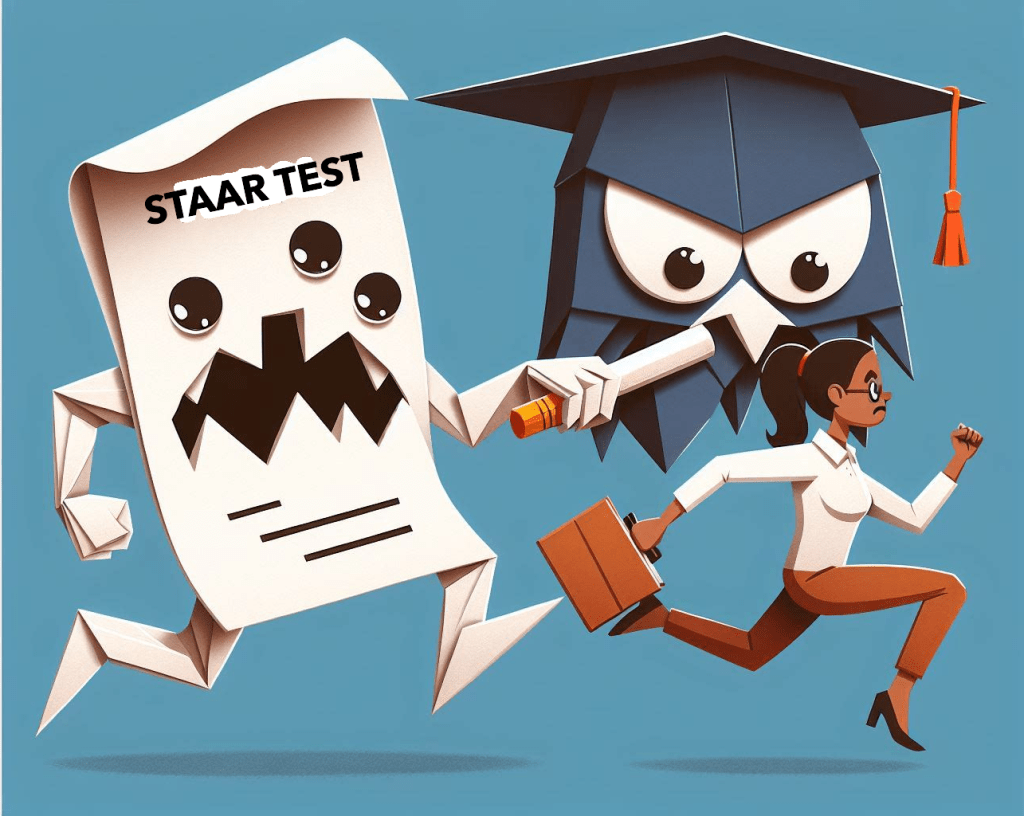
“The problem is that almost every technique and practice we have for understanding how we learn has been about the explicit—the content—in a stable world.” (Thomas, Brown, 2012) Aside from having enough time, the challenge I will face is proving that my lessons align with the standards. In A New Culture of Learning: Cultivating Imagination for a World of Constant Change, the authors mention the need to switch from teaching content to context. As a STAAR-tested subject, when I have classroom observations, one expectation of my classroom is obvious signs that the content is taught. With an inquiry and discussion-based class, although students often use their critical thinking skills to propel discussions forward, it is difficult to pinpoint the TEKS without some type of summative assessment or exit ticket.
Even with the new STAAR 2.0, students have to practice answering multiple-choice questions. The new testing types lend themselves to more discussion-based classes; however, as a teacher, it is still difficult to provide solid data on discussions when we are asked for it in weekly professional learning community (PLC) meetings.
Impacts of CSLE in the Classroom.
Image created by Samara Marin using Copilot 2024
Creating a Significant Learning Environment (CSLE) is important for the learner’s success. According to COVA: Inspire Learning Through Choice, Ownership, and Authentic Experiences, COVA and CSLE work together to create the learning environment. COVA focuses on the student, while CSLE focuses on how each piece of the educational puzzle works together.
“…we often refer to CSLE as a synergy. Therefore, any individual analysis must only be conducted within the broader context of how the instructor creates an environment in which the following components fit together.”
(Harapnuik, Thibodeaux , p.25, 2023)
Therefore, by definition, significant learning environments should be seen from a broad scope. The individual pieces are the student, the instructor, the technology, and anything else in as well as outside of the classroom that could be used to teach students. The importance of thinking on a broader spectrum is, as the title suggests, that we are in a constantly changing world. Even in the context of my five short years as a teacher, what I have used has drastically changed. While I am still using escape rooms in my classroom to teach poetic concepts, those escape rooms have evolved from pieces of paper taped onto the wall to Google Forms or interactive maps on the internet. Could I teach these poetic concepts the traditional way? Yes, but as Thomas and Brown state, “So if games can be made educational, kids will play them longer and learn more—and they may even enjoy learning, too, which would be a welcome and added benefit.” (2012) Children will collaborate in order to win the game against their classmates even if no technology is involved.
These types of questions should be asked when it comes to the broader thinking of CSLE. Educators should take into account how students communicate with each other in and out of the classroom. What is available for the lesson? Is technology necessary for this lesson? If so, should it be in the teachers’ hands or students’? When it comes time to zoom into a lesson, that is where COVA comes into play. When we start to think holistically, we look at what each of our students needs. I have mentioned before that each of my lessons, while carried from year to year, will work differently from year to year. My sophomores this year have different needs from my sophomores last year. Each year, I will tailor the lesson to my group of students.
This is because I have always aligned with the constructivist learning theory, and recently I learned more about the connectivist learning theory. You can read more about how I incorporate those two learning theories to tailor to new sets of students each year below in my learning philosophy.

Learning Philosophies: Cognitive, Behavioral, Constructivist, and Connectivist.
The author reflects on how their experiences as a learner have influenced their role as an educator. They align themselves with constructivism and connectivism as learning theories, emphasizing…


Can I see the Bigger Picture?
Image created by Samara Marin using Copilot 2024
As far as my mindset as a teacher goes, I have always said I am lucky in my first job. My bachelor’s as an English major writing minor gave me a unique perspective. My first teaching job was a STAAR-tested subject, and at the end of my third year as a teacher, I became the head of my department. Not only was I able to have planning meetings across curriculums with other STAAR teachers, but also vertically to see what my department needs at only five years into my teaching career.
While I am still examining the three learning theories, I am drawn to the constructivist learning theory as an English teacher. From the moment I stepped foot in the classroom, I ask the students why—just as much as they ask me. Due to this, I attempt to add discussion time to each week if time allows. Many students have topics they will eagerly discuss in the classroom and those who don’t find interest in listening to the discussions. This discussion time allows them a low-stakes chance to prove and disprove each other’s topic of choice while I quietly moderate and make sure they use valid sources. Small moments like this are what I believe Thomas and Brown mean by almost unlimited access and resources within a bounded and structured environment.

References
Image created by Samara Marin using Copilot 2024
Harapnuik, D., & Thibodeaux, T. (2023). COVA: Inspire Learning Through Choice, Ownership, Voice, and Authentic Experiences (2nd Edition).
Thomas, D., & Brown, J. S. (2011). A New Culture of Learning: Cultivating the Imagination for a World of Constant Change. CreateSpace?


 Marin's Eportfolio
Leave a comment