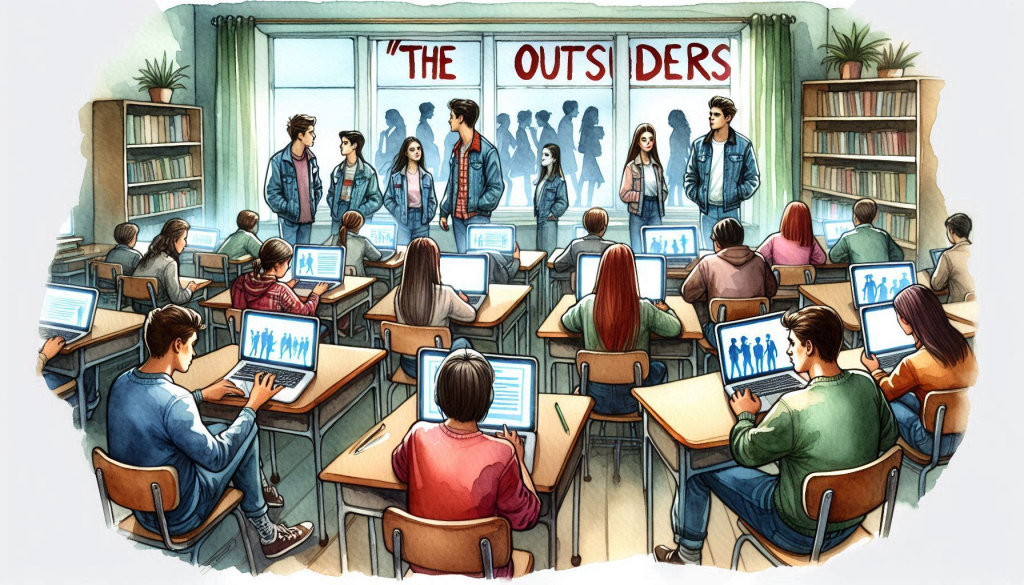
Designing an Online Novel Study Using Fink’s Three-Column Table.
Image created by Samara Marin Using Microsoft Copilot 2024
“Online learning can be a lifeline to those who have obstacles, such as geographical distances or physical disabilities.”
-Paul Levinson
Regarding my teaching style, I know that integrating online aspects works well; however, as the department head for the English department in my district, I often have to create courses for classes within my department. Recently, I was tasked with creating a senior English IV course, and while it does not have to be 100% online as I am down the hall, I decided that for the sake of the students, an online course would be in the best interest of everyone involved. This is because according to a report in NPR, “as of October 2022, after the school year had already begun, 45% of U.S. public schools had at least one teacher vacancy. That’s according to limited federal data” (Turner, 2023). That being said, having everything accessible online does not mean that everything needs to be delivered online. Often, having entire units available to students is helpful if a teacher is absent, a student is absent, or a teacher quits throughout the year. If students know where to find their assignments online, there will be no disruption in student routines in any of the cases, as mentioned earlier.

Students will have an outline of the unit of the course open on their Microsoft TEAMS page so they know what to expect. The outline will follow the TEA TEKS for English IV. By having all of the students’ work accessible online and set up as modules in the form of an outline, students know what to expect and set them up with a routine. By giving students a routine and making them accessible both in person and 100% online, educators hold students accountable for their learning. As an educator, my teaching style is very student-centered because the more students take control of their learning, the more willing they are to express their understanding through discussions. With verbal or written discussions, students have a more challenging time hiding what they do not know. This way, any misunderstandings are evident and cleared up instantly, and the students are a part of the feedforward process by asking questions.

Using an online/blended learning model, I can give students mini-lessons in formative readings or Nearpod videos and have them create projects or complete self-paced modules. Due to this, much of my teaching has been outcome-based education. While I expect every student to learn the same concepts/competencies, not every student starts the class in the same place; therefore, they should be assessed on the outcome. Harapnuik states, “These self-directed, self-motivated, and academically prepared learners will succeed in any learning environment because they know how to learn and assess the quality of their work.” Unfortunately, many see a struggling student and believe they cannot be self-paced. If given the chance, those students often search for their peers to create a mini-learning community within their class or school to complete modules.

Now as far as the approach that I take for planning, I use the Understanding by Design and Bloom’s Taxonomy. Both of these work because, as an outcomes-based educator, I decide what outcome I want my students to achieve and plan backward from there. Our district relies heavily on Bloom’s for lesson planning, and Bloom’s verbs are expected to be seen in our lessons. Nevertheless, the longer I teach, the more I understand the need to give my students an action associated with their learning: today we will analyze, today we will discuss, today we will….etc. Having students constantly writing and discussing their thoughts, I veer more to learning because, through their conversations, students can develop a deeper understanding of each other. Students often use words such as “Well, I thought” and “This is why I thought.” Students usually begin the year by asking permission to join the discussion; however, once they realize it is a conversation and not a gotcha moment, they begin having these discussions more naturally. The next one is “For learning,” because I provide feedback on the discussions if the students cannot arrive at the answer for themselves and provide feedback on their written responses and projects. Finally, the least used form of assessment in my class is “Of learning” because I give “of learning” assessments at the end of a Unit or complete lesson. Even then, I am using less and less multiple choice because I want the assessments to be true testaments of what students have learned in my classroom. Students having discussions with each other while the educator works as a facilitator creates deeper learning as they are in control of their own learning. Working on their assignments at their own pace and creating learning communities within our school system helps them not only take control of their learning but also become responsible for it.

Organizing All Concepts Within a Three-Column Table.
Image created by Samara Marin Using Microsoft Copilot 2024
Using all of my in-person classroom concepts, I have created an online plan for a six-week novel study of “The Outsiders” by S.E. Hinton. This plan bridges English III’s American Literature concepts and English IV’s British Literature concepts.

Learning Outcome for this unit: Students will be able to use what they learned about the 1960s through the prereading and literary analysis of S.E. Hinton’s “The Outsiders ” to write a critical analysis of key differences in socioeconomic classes in America and Britain in the 1960s.
Learning Goals: Assessment Activities: Learning Activities:
| 1. Foundational KnowledgeStudents must understand the social, economic, and cultural climate of the 1960s to understand the setting of S.E. Hinton’s “The Outsiders.” | Prereading Nearpod notes over the 1960s Questions over S.E. Hinton’s life Prereading Writing assignment connected to “We Real Cool” by Gwendolyn Brooks. | Students will learn about the 1960s through a Nearpod. Students will read about S.E. Hinton’s life and how the 1960s affected her writing. Students will read “We Real Cool ” to understand the setting of “The Outsiders.” |
| 2. ApplicationStudents will analyze the story “The Outsiders” using the prereading information they learned. Students will learn the importance of knowing the context in which a story was written. | Character Analysis of “Herd Behavior” analyzes the behavior of greasers and socs. Students will use guided reading and discussion to analyze the socioeconomic tension within the story. Students will write a journal entry as though they were one of the characters. | Students will read an informational text about herd behavior in between chapters. Students will read and discuss chapters while watching chapter analysis videos at the end of each chapter. Once they have completed the video, students will write down what they misunderstood about each chapter. |
| 3. Integration Students will connect the themes of socioeconomic classes and adolescent psychology to their other senior-level courses. | Students will write a journal entry analyzing the characters based on how they discuss each other after chapter 3. | After Chapter 3, we will read Self-Concept, a psychological concepts study that describes how people think about themselves. |
| 4. Human Dimension:Self: Students will learn to develop self-awareness of how they may perceive themselves.Other: Students will learn the importance of having empathy for others. | Students will write reflective journal entries in their Noredink. | The class will have group discussions about identity, belonging, and empathy on the boards or in the classroom notebook. |
| 5. Caring Students will use compassion to understand the struggles and emotions of the characters in “The Outsiders.” | Reflective Journal entries Answer questions for “What Love Isn’t,” and connect to the Novel. Make a connection between the poem and Ponyboy’s Family. | Students will read “What Love Isn’t” and “Healing ‘Brick City’: A Newark Doctor Returns Home” to create links between these texts and the chapters within “The Outsiders.” |
| 6. How to Keep on Learning Students will take what they have learned from the paired texts and “The Outsiders” and write an analysis of the 1960s through the lens of literature. They will make the connection from American Literature to British Literature. | Essay. | Students will complete the reading of the story along with the paired texts “Of Revenge,” “O Captain, My Captain,” and “If” to prepare for their analysis essay. |

Making connections with Literature
Image created by Samara Marin Using Microsoft Copilot 2024
For six weeks, this plan builds on the students’ foundational knowledge created in English III using American Literature. Due to students having a deeper understanding of American society, American Literature will be used as a bridge to make a connection to British Literature by the end of a six-week unit using reading connections and a research project at the end of the unit. The outline below provides further information.
| Weekly Outline For 6 Week Novel Study |
| Week 1-Prereading for “The Outsiders” |
| 1. Students will complete a Nearpod over the YouTube video Crash Course History: The 1960s The reasoning is that, as their teacher, I don’t know what level of knowledge of the 1960s each student has. By ensuring every student starts on the same playing field as far as the level of historical context they have for the novel’s setting, I know every student starts the novel at a similar level after the video is completed. The video will go over the cultural climate of the United States and the world. 2. Students will then complete a Formative lesson about S.E. Hinton’s life and how the cultural/social climate of the 1960s influenced her writing. The reasoning behind this assignment is similar to the one before. Students will develop the necessary foundational knowledge to read the book. As the teacher, ensuring students know about the author whose work they will interact with is important. S.E. Hinton was influenced heavily by the climate and even by the fact that she was a woman writer in the 1960s, which many readers would not catch simply by reading her pen name. 3. Students will read Gwendolyn Brooks’s “We Real Cool” to receive a short introduction to what scenes in The Outsiders could look like. The reasoning behind this assignment is that “We Real Cool” is a short text that prepares students to create a character analysis. Students will read the poem, answer questions to ensure understanding, and then write a journal/diary entry as though they were one of the billiards players in “We Real Cool” or the narrator to prepare to write weekly journal entries. |
| Week 2: Getting Started and Making Connections |
| 1. To bridge the foundational knowledge with the reading, students will complete a formative assignment to learn more in-depth how the 1960s influenced the writing of The Outsiders specifically. The assignment will slowly go into the themes that will be present in the books so students can begin to form predictions. The reasoning is so students can begin to make personal connections with the book instead of simply reading it because they are told to do so. The more a student knows about the book and its background, the more likely a student is to participate in the discourse involving the book. 2. In the same formative assignment, students will write their second journal entry in which they answer the prompt, “Imagine you are living in a world where people are divided into two groups based on their social and economic status. One group is wealthy and privileged, while the others struggle to make ends meet. Write a journal entry from the perspective of a teenager living in this world. Describe your daily life, feelings about the other group, and any conflicts or friendships you have experienced.” This assignment gives the teacher an understanding of what students know about socioeconomic statuses in the 1960s and currently. This will allow students to be ready for any discourse that will be had in the classroom. 3. For this week, students will read/listen to four (1-4) chapters while answering questions as they read. The reasoning for this is by answering questions as they read, students will be able to see where they are misunderstanding their reading. 4. Students Will also read/listen to “Herd Behavior” by the CommonLit Staff and “Self-Concept” by Saul McLeod. Then, students will decide whether to write a short analysis essay on the herd behavior exhibited in Chapter 2, the characters in the novel’s ideal self-conflicting with their portrayal, or which characters have a strong self-image. The reasoning behind these readings is that each piece is an informational text that connects heavily with the themes in chapters 1-4. Giving students a choice between preselected prompts makes them more likely to resonate with one than the other. Some students may even narrow down the prompt, and if they can defend it, I allow them to write over their chosen prompt. 5. Weekly Journal entry: This week, students’ journal entries will also be a choice in which they discuss either herd behavior or self-concept in their personal lives. The reasoning is that having students journal weekly is a way to prepare them for writing after high school. |
| Week 3- Making Emotional Connections |
| 1. For this week, students will read/listen to four (5-8) chapters while answering questions as they read. The reasoning for this is by answering questions as they read, students will be able to see where they are misunderstanding their reading. 2. Students will also read “What Love Isn’t” By Ysra Daley-Ward after completing chapter 6. In a discussion post, students will answer the question, “using Daley-Ward’s poem-and her idea that love is not uniform or mainstream- to define what love is and isn’t within Ponyboy’s family. How does Darry and Ponyboy’s relationship Change after the church fire?” The reasoning for this is so students can see how the idea of love can be subjective, and there are different types of love. This will show students to provide evidence in order to create “correct” answers. If they can back up their answers with evidence, then they will receive the credit. 3. Students will read “Healing ‘Brick City’: A Newark Doctor Returns Home by NPR Staff after completing chapter 7. Then, in a discussion post, students will answer, “Consider how Ponyboy and Johnny’s Heroic act can change the community. How does this contrast with Sampson Davis’s Views and experience? Using Sampson Davis’ Life Story as a reference, how did Ponyboy and Johnny’s life experiences prepare them to be heroes? The reasoning for this is the same as the previous assignments, students need to be able to find evidence for opinion-based statements. Just as everyone has a different definition for love everyone has a different definition of a hero. 4. Weekly Journal entry: This week, students will journal about heroes or the different kinds of love that exist. The reasoning is that having students journal weekly is a way to prepare them for writing after high school. |
| Week 4-Beginning to Bridge American Literature to British Literature. |
| 1. Before students begin this week’s reading, they will be introduced to the final project for the novel study. Just as we learned the background knowledge necessary to dive into S.E. Hinton’s writing, students will have two weeks to research either a British author who is famous in America or an American author who is famous in Britain. The reasoning is that English IV focuses on British literature after Unit 1. In Unit 1, students learn the importance of connecting and interacting with the reading. In units 2-6, students take what they learned in Unit 1 and apply it to different forms of reading and writing throughout the year. However, English III was all about American Literature; by beginning the year with an American Novel and having students bridge their way into British literature or culture after gaining foundational knowledge, students will be better prepared to tackle it. By specifically writing about an author from one country who is also popular in the other, students can learn about some cultural differences between the countries that the author may have had to overcome. *The essay will be written in weeks 5-6; however, introducing it in week 4 gives students a week to think of any questions they may have before beginning to work on it.* 2. For this week, students will read/listen to four (9-12) chapters while answering questions as they read. The reasoning for this is by answering questions as they read, students will be able to see where they are misunderstanding their reading. 3. Students will read “Of Revenge” by Sir Francis Bacon after Chapter 9. A British author writes this text and discusses the notion of revenge and the consequences of having a fixation on it. Students will respond to a discussion post, “after evaluating the motivations and consequences of revenge. How do you feel about the planned rumble in the novel? What are your predictions for this event? What consequences could the characters face? Based on the poem, would the rumble be worthwhile? The reasoning for this reading is that it sends home the idea that revenge, whether in life or the novel, is not worth it. It is also the first connection students make with British Literature. 4. After reading Chapter 10, students will read Walt Whitman’s “O Captain! My Captain!” This poem discusses themes of loss and grief. Once students finish the poem, they will respond to the discussion post, “Consider how Ponyboy compares to the speaker in the poem in their experiences of loss and moving on. What are the results for the two characters after the loss of friends? This assignment allows students to see various perspectives on the same theme. 5. Weekly Journal Entry: Students will write about loss and revenge in real life, movies, books, or shows. The reasoning is that having students journal weekly is a way to prepare them for writing after high school. |
| Week 5- Novel Wrap and Research Paper. |
| 1. Students will read “If” by Rudyard Kipling, where the speaker discusses rules for their son’s life. The students will write their weekly journal entries at the beginning of each week. “Compare the poem’s main idea to the virtues presented in the novel. What type of future does the speaker in the poem and Darry in the novel wish on the characters’ lives? As seniors, what predictions do you have for your own lives?” The reasoning behind this week’s journal entry is to have students conclude the novel and make personal connections by looking at their future, similar to how Darry and the speaker do. 2. Students will begin to look for a British author famous in America. By finding an author that is popular in America and Britain, students will be able to research the cultural, societal, and global influences on the author’s work during the period in which they wrote their texts. 3. Students will then research their author, reviewing all parts of the writing process within weeks 5 and 6. This will ensure students receive a refresher on the research and writing process for their final research paper at the end of the year. 4. Weekly journal writing: How do you feel about your research paper? Name at least one aspect of your research paper in which I, the instructor, can assist. |
| Week 6- Research Paper Wrap and PowerPoint. |
| 1. Students will complete their research paper. The research paper will be submitted at the end of Week 6. 2. Students will create a PowerPoint of their research paper and submit it with their research paper. This ensures that students write their papers and know how to summarize information accurately. |

References
Image created by Samara Marin Using Microsoft Copilot 2024
Athuraliya, A. (2023, January 5). Top 7 Instructional Design Models to Create Effective Learning Material –. Creately Blog. https://creately.com/blog/education/instructional-design-models-process/
Harapnuik, D. (2020a, April 30). Feedforward Vs. Feedback. Harapnuik.org. https://www.harapnuik.org/?p=8273
Harapnuik, D. (2020b, May). Why I Don’t Use Checklists, Progress Bars & Other Activity Monitors. Harapnuik.org. https://www.harapnuik.org/?p=8314
Harapnuik, D. (2021). Assessment OF/FOR/AS Learning. Harapnuik.org. https://www.harapnuik.org/?page_id=8900
Turner, C., & Cohen, N. (2023, March 23). 6 Things to Know About U.S. Teacher Shortages and How to Solve Them. NPR. https://www.npr.org/2023/03/23/1164800932/teacher-shortages-schools-explainer#:~:text=As%20of%20October%202022%2C%20after%20the%20school%20year,teacher%20vacancy.%20That%27s%20according%20to%20limited%20federal%20data.


 Marin's Eportfolio
Leave a comment