Created by Samara Marin using Microsoft Copilot 2024
“The secret to change is to focus all of your energy not on fighting the old, but on building the new”
-Socrates
When creating an alternative professional learning environment for my district, I first looked at what was already available. Once I took stock of the procedures we currently have in place, I realized I could mold what we already had into a professional learning environment that would be more beneficial to our district’s educators. It is easier to shift directions than to change the direction we are going completely. In other words, how can I make the pieces I already have fit into the picture I am trying to create?
Created by Samara Marin using Microsoft Copilot 2024
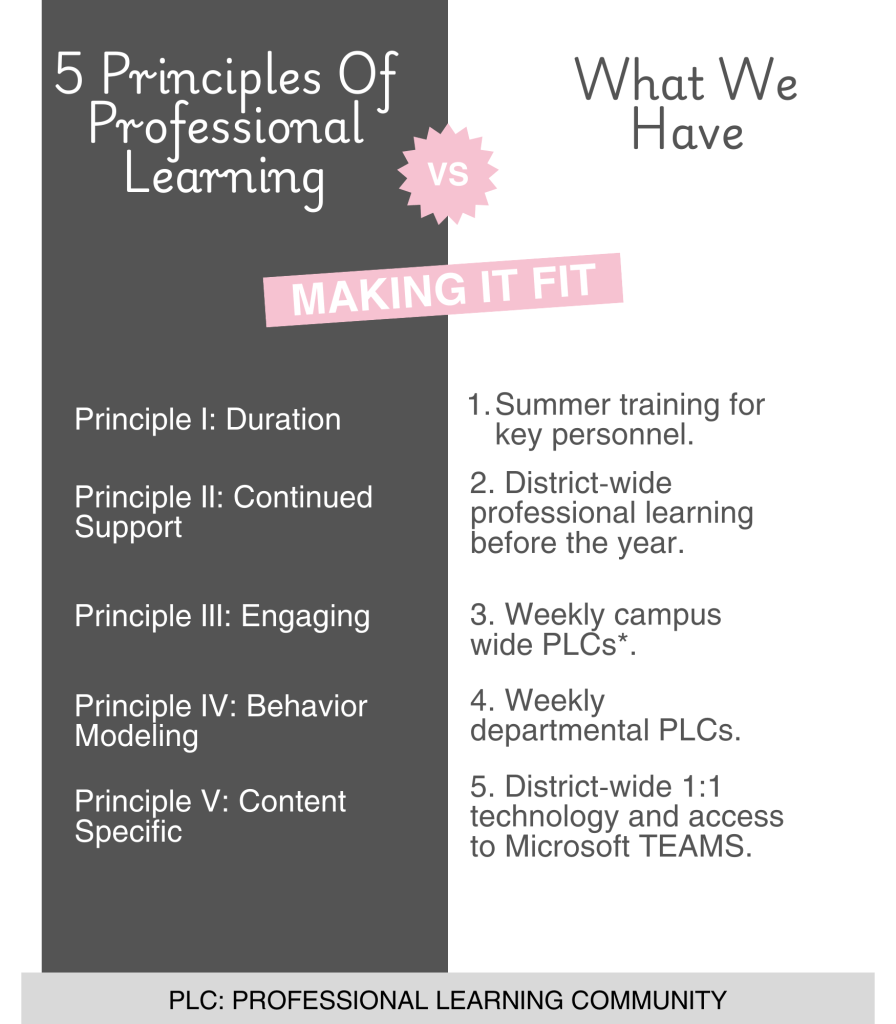
So, what pieces are already in place, and how can they fit into an improved professional learning environment? Below is a chart that shows what research has shown are the 5 Principles of Professional Learning as outlined in Teaching the Teachers: Effective Professional Development in an Era of High Stakes Accountability by Allison Gulamhussein, as well as what our district already has in place for professional learning.
Created by Samara Marin Using Canva 2024
Now that we have laid out what is available, how can what we have be shifted into the five principles of effective professional development?
Principle I: Duration- The professional learning must be consistent, not just a one-and-done situation. To create a professional learning environment that is consistent and continuous, I plan to create a plan forkey personnel to be trained over the summer in AI resources and ethics. Hence, the initial exposure for our districts is purposeful and in small groups. At the professional development offered before the school year begins, everyone will be introduced to the concepts as a district as well as introduced to a district Microsoft TEAMS page where educators within the district can ask questions across the district. Then, one of the weekly departmental PLCs each month will be designated as a show and tell of the implementation process within the classroom so that each department can present its implementation process to the campus during campus-wide PLCs.
Principle II: Continued Support- By having educators use one weekly departmental PLC a month to review the implementation process, the department can support each other in coming up with a solution while still having each educator take responsibility for their learning. The district-wide Microsoft TEAMs forum will also serve as a place for educators to ask questions and see if anyone within the district may have a solution. Finally, using one of the campus-wide weekly PLCs a month to demonstrate how different departments use professional learning will provide a place for educators to gain more resources or ask questions in person. The key personnel trained in AI resources and ethics over the summer will also be from each campus on district ensuring each campus has a point of contact in case they need help troubleshooting what they are having trouble with.
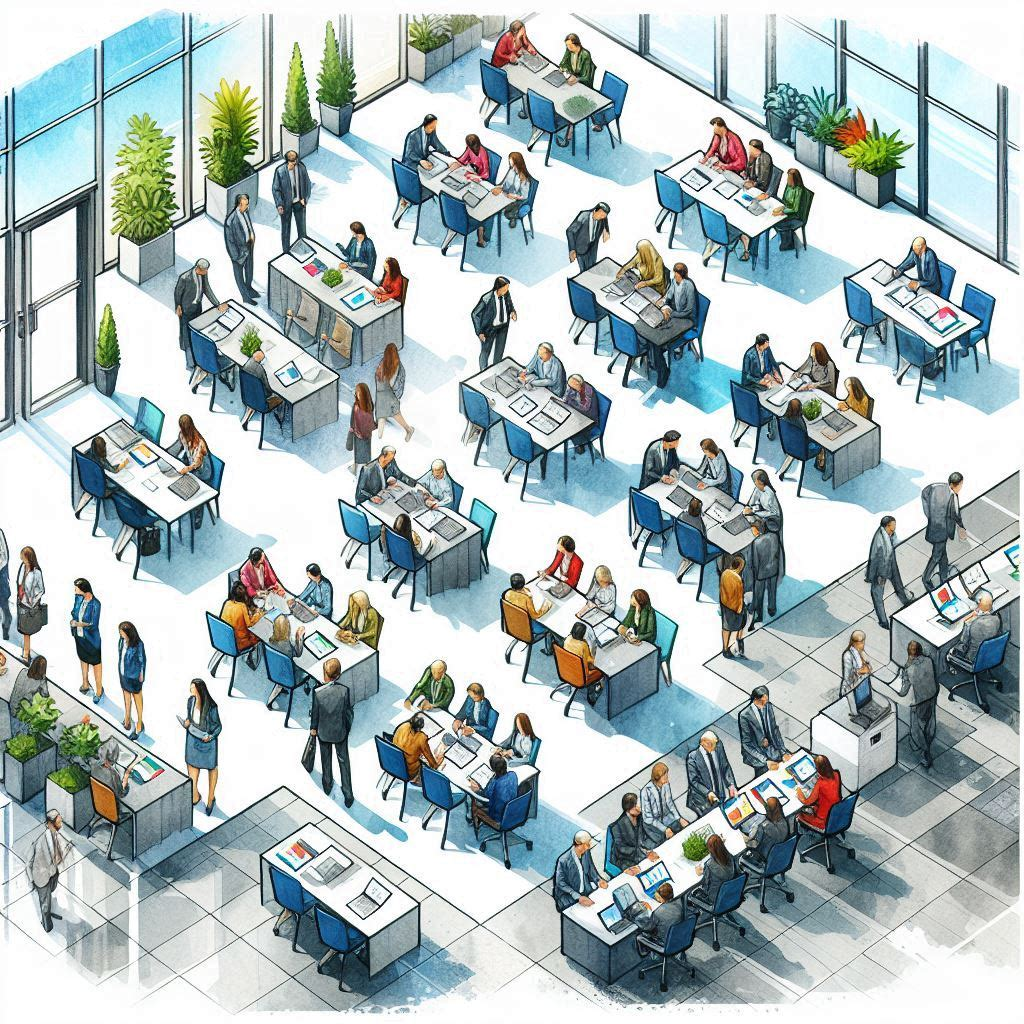
Principle III: Engaging—By having key personnel from each campus trained in AI resources and ethics over the summer, there will be more opportunities for the initial introduction to AI resources in a small group environment. Even if professional learning is presented district-wide, having multiple presenters evenly dispersed in the room will give educators a better opportunity to interact with their learning during the initial exposure. Creating a small group environment makes discussions more accessible if there are multiple facilitators. This will also allow for educators to have more time to interact with the resource of their choosing due to having multiple mentors available to answer questions.
Principle IV: Behavior Modeling- Once the initial exposure to the information is given and discussed in a large group, there will be break-out rooms led by the key personnel trained over the summer in AI resources and ethics. Each breakout room will model different resource use for various grade levels. Educators will be allowed to watch at minimum two different breakout rooms. There will also be videos of other resources used in the district Microsoft TEAMS page. This will enable educators to have 24/7 access to resources. The Microsoft TEAMS page will also be a place for educators to demonstrate how they are using the resources provided, so the district will create a library of resources.
Principle V: Content Specific- By having key personnel from each campus within the district train over the summer, the breakout rooms will be specific to each grade level. The departmental PLCs will create content-specific resources over time. By having educators work together to build the PLCs (whether departmental or campus-wide) throughout the year, the district will have a working list of resources that can be added and updated when new resources are found through collaboration.
By involving the district educators instead of bringing in outside companies when leading PLCs, the goal is to have more district-specific resources that will be used long-term. Knowing that the ones leading the professional learning exist within the district, educators will have easier access to asking follow-up questions during the implementation process.
Collaborating from Smallest to Largest Group
Created by Samara Marin using Microsoft Copilot 2024
From beginning to end, the constructivist principles of my professional learning plan rely on successful collaboration. From key personnel from each campus training together and creating their presentations over the summer to the once-a-month departmental PLCs dedicated to discussing the implementation process. Each educator will arrive with a different level of understanding when it comes to AI resources and ethics. By creating various spaces for educators to discuss the implementation process throughout the year, we can build up each educator. A case study of an Ottawa Catholic school states, “Teacher PD has changed from traditional sessions led by outside presenters and system staff to staff-generated and -led professional learning” (2016). In order to be implemented, professional learning needs to be relevant to those learning, and what better way to ensure relevancy than having the educators assist in creating the year-long professional learning environment?
What will be used and their purpose is below:
Created by Samara Marin using Canva 2024
By giving educators multiple ways to ask questions and showcase what they’ve learned, everyone will have a chance to share a part of their learner’s journey with at least one of the three collaboration groups. “A classic example of active learning is a think–pair–share discussion, in which students think about a question posed by the instructor, pair up with other students to discuss the question, and share answers with the entire class” (Andrews et al., 2017) by having multiple locations for educators to collaborate and share, we are taking the “think-pair-share” concept to the district level.
Leaders Emerging From COVA
Created by Samara Marin using Microsoft Copilot 2024
The goal of my alternative PL plan is to empower the individual educator in their learner’s journey. By giving them various points of contact online and in person, the individual will amass an AI resource toolkit that is specific to their classroom. In addition to creating their own toolkit, constructivist principles will create an environment where anyone can lead a district PL on one of their chosen resources or AI strategies. Below is an infographic explaining what each level of PLs is for:
Created by Samara Marin using Canva 2024
By giving educators choices on where they can collaborate as well as a place to share their ideas, educators will take ownership of their professional learning. The goal is to create a community where educators can share their voices in order to make their learning authentic in their classroom. The principles of COVA can work for professional learning communities as well, as in the context of professional learning, the educators are the students. The ultimate goal of my innovation plan is to help educators create a blended learning environment with a flipped classroom as the end goal. However, COVA shows that while that is my goal, it may not be the goal of every educator in my district; therefore, my professional learning plan allows each educator to individualize their own learning for their specific needs. My district is already resource heavy, and everyday a different resource we already use incorporates AI into their platform; however, due to whirlwind of day to day tasks, many of our educators don’t know how to use the rapidly changing resources available to us.
Finks 3-Column Table and Professional Learning.
created by Samara Marin using Microsoft Copilot 2024
Fink’s 3-column table is a great way to esblish any goals for any learning environment. In this case, it is what I will be using to explain the goals of my professional learning plan.
BHAG: By the end of the year, educators within the district will be empowered to effectively integrate AI resources into their classrooms while upholding the highest ethical standards, fostering a new generation of students who are not only technologically proficient but also ethically conscious.
3-Column Table
Learning Goals
Assessment Activities
Learning Activities
Foundational Knowledge Understand the basics of AI and its ethical implications. Understand which available resources already have AI integrated as well as establish ethical uses for AI within the classroom.
Gimkit and Blooket to check for understanding during the professional development. Educators will also create their own professsional development to share in one of the three professional learning communities.
Interactive Webinars: Participate in live webinars with AI experts and ethicists. Gamified Learning Modules: Complete AI and ethics modules with quizzes and badges. Collaborative Discussions: Participate in discussions during in person PLCs and on the Microsoft TEAMs Page.
Application Apply AI tools and resources in educational settings such as lesson planning, within classroom assignments, and in the grading sphere. Understand the 80/20 rule of AI usage as well as AI’s uses for task automation to create a blended classroom.
Discussions held both in person and online in the TEAMS page.
Lessonplan creation
Professional Development creation.
Collaborative Projects: Work in teams to design AI-integrated lesson plans. Simulations: Use AI simulations to practice classroom applications. Videos On Teams: Watch videos created by key personnel and other members of the TEAMs community on the TEAMS page.
Integration Connect AI knowledge with ethical practices and educational goals. AI can be used to enhance already created lessons with a few simple prompts.
Discussions held both in person and online in the TEAMS page.
Lessonplan creation
Professional Development creation.
Classroom walkthroughs and sharing with administration when creating lesson plans.
Interdisciplinary Workshops: Participate in workshops that combine AI with other subjects. Panel Discussions: Engage in panel discussions with AI and ethics experts and each other. Case Study Analysis: Analyze real-world case studies on AI integration.
Human Dimension Recognize the impact of AI on students and society. AI is already making its way into the educational sphere, how will AI change the landscape beyond the classroom?
Self-assessment on ethical understanding Peer feedback on role-playing activities Analysis of case study outcomes Collaborative discussion over the community and student response to AI seminars.
Community Dialogues: Facilitate community dialogues on AI’s societal impact in order to involve parents in the discussion. Personal Reflection: Reflect on personal and professional responsibilities in AI use. Student Reflection: Have educators discuss the implications of AI on society with their students.
Caring Develop a commitment to ethical AI use in education. Educators will be a part of the AI discussion whether we want to or not. The more informed we are the more productive these discussions will be.
Professional Development on resources found. Discussions on the TEAMs page and in person.
Mentorship Programs: Engage in mentorship programs with experienced educators. Assisting through TEAMs: Engage with fellow educators within the district to solve problems concerning AI.
How to Keep Learning Cultivate skills for continuous learning over new AI resources being released and ethical decision-making. Share resources and implementation with the collaboration groups.
Keep track of Professional development attended through the course of the year Individual or team research on common AI topics Continued research on the implementation of AI.
– Research Challenges: Take on research challenges to explore AI topics. Lifelong Learning Seminars: Attend seminars on lifelong learning strategies. Ethical Decision-Making Workshops: Participate in workshops on ethical decision-making frameworks.
Professional Learning Schedule
Created by Samara Marin using Microsoft Copilot 2024
The schedule will be divided into three phases: the pre-implementation phase, the district-wide implementation phase, the ongoing mentorship phase, and the reflection phase.
Outline of Professional Learning
Pre-implementation Phase– This phase will take place during the summer before the school year begins.
Key Personnel Training- These personnel will be representatives from each campus in charge of the initial professional learning and breakout rooms. This team will consist of one person from each campus who will serve as the primary mentor for each during the first few weeks of implementation while AI resource leaders emerge at each campus.
Microsoft TEAMs creation- The TEAMs page will be set up over the summer and the join code will be sent to each educator over the summer. This will have the discussion forum for educators to collaborate district wide ready by the first day of professional learning before the school year begins.
District-Wide Implementation Phase– This will be most educators within the districts first exposure to the AI resources available to them. This will take place during the professional learning implemented before the first day of school.
District-Wide Professional learning- The key personnel will collaborate on an introductory course in which general AI resources and ethical ways AI can be implemented are introduced. While one or two are the main presenters, the rest of the key personnel will be facilitators, ensuring they walk around and assist with the discussions taking place.
Content/Grade Specific Breakout rooms- Once the introductory course is completed, educators will continue into breakout rooms prepared by each individual key-personnel to ensure they receive more specified resources as well as discussions that pertain to their grade level.
Response to breakout rooms- In order to demonstrate the purpose of the TEAMs page, educators will respond to a reflection question in the TEAMs page.
The Ongoing Mentorship Phase- This will take place throughout the year.
Key Personnel will work with their campuses to ensure campus-wide and departmental PLCs have the necessary support.
Mid-year Goal- The goal is for technology leaders to emerge by the end of the first semester.
Departmental PLCs- One of four monthly PLCs will be dedicated to the AI resources and ethical implementation in the classroom.
Campus-Wide PLCs- Each department will take turns to present each month to demonstrate any resources or implementation practices working for them.
Reflection Phase- This will take place during the last month of the year, educators can sign up to give a professional development on what they have learned, how their students used AI ethically, how they got past hurdles, etc.
The discussion posts will also be used to see if any educators will want to work collaboratively accross the campuses for the end of the year professional development.
This is a rough outline of what will be expected during each phase of the professional learning plan. The primary resources needed to kickstart the professional learning plan will be Microsoft TEAMs and Clever. Clever is a single sign-on service that houses all district-provided resources as well as any compatible resources educators choose to save. The Resources introduced at the beginning of the year will be Microsoft Copilot, Khan Academy’s Khanmigo, Magicschool.ai, Formative‘s AI, and Noredink‘s AI. Overall, professional learning will be a way to introduce new resources as well as a new way to learn collaboratively.
References
Created By Samara Marin using Microsoft Copilot 2024
Andrews, T. M., Ecology, *Department of, Leonard, M. J., Education, D. of, Colgrove, C. A., Kalinowski, S. T., D, A., DL, A., TM, A., TA, A., DA, B., B, B., M, B., CC, B., CH, C., A, C., L, D., WP, D., D, E.-M., … Breckler, J. L. (2017, October 13). Active Learning Not Associated With Student Learning in a Random Sample of College Biology Courses. CBE-Life Sciences Education. https://www.lifescied.org/doi/10.1187/cbe.11-07-0061
Gulamhussein, A. (2013). Teaching the Teachers Effective Professional Development in the Era of High Stakes Accountability. National School Board Association, Center for Public Education. – references – scientific research publishing. (n.d.). https://www.scirp.org/reference/ReferencesPapers?ReferenceID=2604930
[…] from the initial introduction to the materials and the coaching from key personnel mentioned in the enhancing professional learning post, most of what comes out of this professional learning will be created by the educators at each […]












 Marin's Eportfolio
Leave a comment