Backward Design and Clear Pictures
Image created by Samara Marin using Copilot 2024
When it comes to lesson planning, one quote always pops up in every professional development that we must attend: “If you fail to plan, you plan to fail.” Isn’t it interesting that a significant portion of our studies into creating a significant learning environment involves creating well-developed courses or units? While these plans may not be weekly plans, they help educators create more focused weekly lesson plans. “Our lessons, units, and courses should be logically inferred from the results sought, not derived from the methods, books, and activities with which we are most comfortable” (McTighe, Wiggins, 2008). By knowing the results we want from our students at the end of the course or even the unit, we can more easily align our weekly plans across the year.
As a campus and with the new STAAR 2.0, one of the benefits I’ve noticed with having entire units laid out using the backward design model is it makes for easier collaboration with other educators. If I know what my units will look like on a larger scale, then I can not only vertically align within my department, but also horizontally align across my grade level. My favorite example of backward planning in my classroom is my final project for my class.
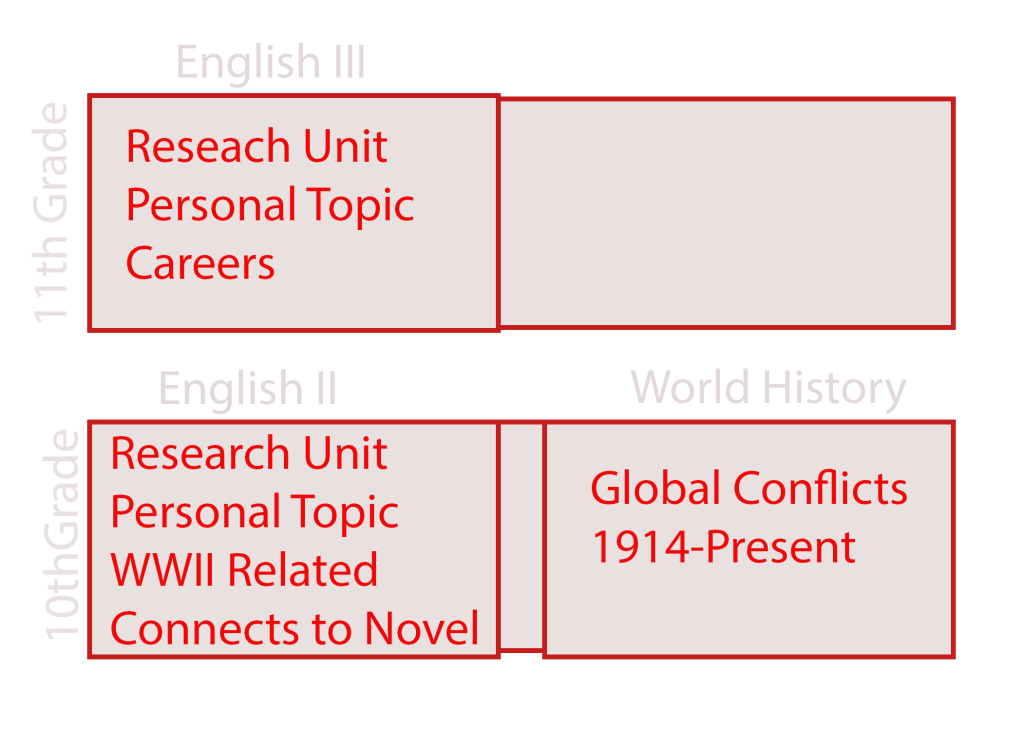
The image above shows how the final English II research paper aligns vertically and horizontally. In class, we complete a six-week novel study with the research paper. The novel is a historical fiction novel, which allows us to make the cross-curricular connection to world history and its global conflicts unit. These units take place in the final six weeks of the school year according to each subject’s year at a glance. The same final research paper aligns vertically because both English II and III have final MLA-style research papers requiring choosing personal topics. The difference is that English III’s connection is with career technology and education courses, as the topic must be career-oriented. If we as educators were to have a professional learning community (PLC) meeting without any planning documents detailing our plans for a unit, we would not be able to see these cross-curricular and cross-grade level connections. The UbD template lets us, as educators, take a “bird’s-eye view” of our units and compare them to see where we can connect to prior learning.

Creating Courses that Align with Outcomes
Image created by Samara Marin using Copilot 2024
Summary of Unit: In this unit, students learn about World War II and the Holocaust. Through a historical novel study, students chose their groups and their projects in order to demonstrate the ability to work collaboratively with their groups to create a cohesive multimodal presentation which includes: a research paper, PowerPoint, and teaching presentation of 3-5 minutes. Groups are in charge of creating a proposal, work outline detailing the research tasks for each group member, keep track of weekly check-ins, rough draft, final draft, and PowerPoint by the end for the unit. Students will learn how to format essays and citations in MLA format through this research paper in order to continue using MLA format in English III.
| Understanding by Design Unit planning template Identify Goals & Understandings > Assessment> Activities | |
| Stage 1 Desired Results School Driven results for this unit is to improve student research ability in order to prepare students for dual-credit courses and college after graduation. Students will continue using MLA format through their 11th and 12th grade year. | |
| Established Goals/Transfer Goal: What do students need to learn and be able to do? Include essential standards. Students need to be able to format research papers into MLA format. Students need to be able to differentiate between credible and non-credible sources in order to synthesize information from multiple sources. Students will have to be able to create personal connections to their research paper. Students will be able to work collaboratively in order to create cohesive products for their research paper. When it comes to their reading, students will be able to analyze isolated scenes and characters in order to understand how the author was able to create believable characters. E2.4E: Make connections to personal experiences, ideas in other texts, and society. E2.7F: Analyze characteristics of multimodal and digital texts. E2.11I: Use an appropriate mode of delivery, whether written, oral, or multimodal, to present results. E2.11A: Develop questions for formal and informal inquiry. E2.11B: Critique the research process at each step to implement changes as needs occur and are identified. E2.11D: Modify the major research question as necessary to refocus the research plan. E2.11C: Develop and revise a plan. E2.11H: Display academic citations, including for paraphrased and quoted text, and use source materials ethically to avoid plagiarism. E2.11G.i: Credibility and bias, including omission. E2.11F: Synthesize information from a variety of sources. E2.11E: Locate relevant sources. E2.7D.i: clear thesis, relevant supporting evidence, pertinent examples, and conclusion E2.6A: Analyze how themes are developed through characterization and plot, including comparing similar themes in a variety of literary texts representing different cultures. E2.6B: Analyze how authors develop complex yet believable characters, including archetypes, through historical and cultural settings and events. E2.6D: Analyze how historical and cultural settings influence characterization, plot, and theme across texts. E2.7A: Read and analyze world literature across literary periods. E2.8A: Analyze the author’s purpose, audience, and message within a text. E2.8D: Analyze how the author’s use of language informs and shapes the perception of readers. | |
| Enduring Understandings: What understandings are desired about the big ideas of this unit? The big ideas from this unit are the historical context of the research paper. Students should know how to develop a research paper by the end of this unit and collaborate effectively with classmates. Students should also learn how to make connections in their learning. | Essential Questions: What questions(s) will guide inquiry and point toward the big ideas and transfer goals of the unit? 1. How do the decisions and actions of characters reveal their personalities? 2. How does a thesis statement drive a research paper? 3. How can a topic of interest drive a research paper? 4. How do I employ author’s craft in my writing? 5. How do the conventions of language help me understand what I am reading? 6. Depending on the situation, are there better ways to communicate? |
| Students will know… By the end of this unit students will know: 1. A timeline of WWII. 2. The rhetorical devices. 3. The logical fallacies. 4. MLA formatting. 5. Where to find the MLA formatting style guide online. 6. How to create a character analysis. | Students will be able to… What will students know and be able to do by the end of the unit? List the few most important discrete knowledge and skill goals that are separate from the transfer goals. 1. Students will be able to create a well formatted MLA research paper. 2. Students will be able to summarize a research paper in a PowerPoint. 3. Students will be able to give an oral presentation. 4. Students will be able to work collaboratively to create multiple digital products. 5. Students will be able to work collaboratively to be able to delegate tasks effectively. |
| Stage 2 Assessment Evidence: Teacher and School Driven How will we know if students have learned? We will know if students are learning during weekly check-ins. We will know if students have learned through the final research essay that is turned in at the end of the year. | |
| Formative Assessments: Formative assessments are weekly writing workshops in which each group has a conference with the teacher to receive feedback on the formatting and content of the research paper. For the novel study, formative assessments include but are not limited to class discussions, exit tickets, and “do now” assignments. | Summative Summary in GRASPS form Here is where you will develop a scenario for the activity/project. This section is for you to develop a guide for the students on what to do. Goal(s): Scenario for Assignment/Project The goal is for the group of 2-3 students to create a cohesive research paper and PowerPoint that summarizes the paper and presents said PowerPoint as a teaching project. This is their end-of-the-year final project, for which students have 5-6 weeks to create all aspects, including an initial proposal letter at the beginning of the six weeks. Role: The student’s role in the project is to become the teacher. This is the final project in the class. Students are tasked with researching a WWII-related topic that they can connect to a personal interest and research. Once they have their paper, they create a presentation in order to teach the class what they learned. Audience: Who will see this information? The teacher and the students’ classmates will be the intended audience for the information, as this is their final teaching project. Situation: How – individually, partners, groups – the goal will be accomplished. It is both an individual and group project. This is possible as students will submit two versions of the final draft. One that is color-coded showing each student’s contribution, and one that is black and white. Each group is also charged with turning in designated group “tasks” for each student weekly. This ensures that if a specific aspect of the project is missing only the student tasked with the missing piece has points deducted. Performance: What will the student do? Students will create a research paper, and PowerPoint, and present the PowerPoint to the class. Standards: Students will have a rubric for each part of the project. There will be a rubric for the research paper, PowerPoint, and oral presentation. |
| Key Criteria to reflect performance task students will be given both checklists and rubrics in order to maximize success. There will also be weekly check-ins with each group. | Other Evidence (essay, work sample) What other evidence (formative, observations. Home learning, etc.) will be collected to determine whether or not Desired Results have been achieved? Every aspect of the research process will be assessed, whether formally or informally, including discussions with students. The instructor works as a facilitator for student success in this project. Students will be assessed through weekly check-ins, discussions, proposals, rough drafts, final drafts, PowerPoint presentations, and Oral Presentations, as this is a six-week project. |
| Stage 3 Learning Plan Activities: (Teacher Driven) How will students engage in learning? Students will engage in learning through the research paper and the novel/character analysis. | |
| Consider the WHERETO elements These questions are/can be directed as…. What the teacher and/or the student do in regards to the WHERETO. W Where are we going? What is expected? The teacher is expected to work as a facilitator for discussions. Students will be given discussion questions and timelines to analyze and have in-depth discussions about the novel. The teacher will work as a writing center for the research paper to workshop student essays. Students must work together to dissect the novel and complete their research projects. H How will we hook (Introduce this to) the students? Students will be introduced to the project with a short history lesson, a mini MLA lesson, and the boundaries within which they can choose their topics. The teacher will hook students by using student interests to demonstrate the variety of possible topics students can choose from. E How will we equip students for expected performances? Students will be given a form that looks similar to a contract. This will show students the importance of reading through all aspects of anything before signing. The contract will have all necessary due dates for the six weeks, all necessary rubrics, and a link to the Purdue Owl MLA formatting website. Students will then be given a lecture on the research paper. R How will you rethink or revise? What are likely or predictable student misunderstandings and/or performance weaknesses in this unit? What do the research and teacher experience say we can expect the greatest difficulties to be? What suggestions can you offer about how to troubleshoot these issues? This is the sixth year using this research paper. Adjustments that I have made over the years are: 1. I added the color-coded copy of the final draft to show the collaboration. 2. The proposal was added to help students prove they are choosing topics they are at least somewhat familiar with through pre-research. 3. I added the rough draft with two checkpoints to ensure students don’t wait until the night before the essay is due. 4. I made the rough draft due a week before the final draft to ensure students revise and edit, as well as have enough time to complete their PowerPoint and rehearse. 5. I added the task delegation component to reduce group arguments. E How will students self-evaluate and reflect on their learning? The platform that I use for the check-ins gives students instant feedback on grammar and organization. Students are able to create their own revising and editing plans based on their feedback. They will have their two check-ins on this platform as well as three chances to submit their final draft for an improved score. Students also have to complete an anonymous survey about how well the group worked together, including one about themself. T How will we tailor learning to varied needs, interests, and learning styles? The resource room has a copy of the essay to assist students with accommodations. Each group has the option to delegate tasks based on individual student abilities. For example, if one student is better at writing while another is better at PowerPoint presentations, that group can delegate tasks how they see fit. They must both carry equal research weight; however, they must explain their reasoning and prove that both parties agree. O How will we organize the sequence of learning? The sequence of learning follows the research process. Students will read and analyze 6 chapters a week for the reading having weekly discussions and character analysis discussions. There are also weekly quizzes that include short constructed responses. The first week is pre-reading which is a short history lesson into WWII and the Holocaust. For the research paper it goes as follows: End of Week 1: Pre-research and typing of the proposal letters. Student letters must respond to the questions: What is your topic? And why did you chose it? End of Week 2: Research and distribution of tasks. Students must turn in a task distribution sheet detailing what each group member is in charge of. End of Week 3: First check in to see how the research paper is going for each group. We workshop formatting and ensure students have a foundation for their organization. End of Week 4: Second check-in rough drafts are due. This gives students a week to complete final drafts and PowerPoints. (Each item due is due at the end of a 7 day period.) End of Week 5: Student final drafts and PowerPoints are due so teacher can grade. Week 6: Students spend the week presenting. | Resources What print and web resource best supports the unit? Also provide additional resources used in planning for activities or during instruction. In order to plan this unit I use the English II and World History year at a glance. The Boy in the Striped Pajamas serves as a powerful tool for conducting in-depth character analysis, enriching our instructional design. Students are given access to Purdue Owl, and Google Scholar, and are shown the best practices for researching. Students are able to work collaboratively from home and at school through Google docs or Microsoft word. |
| Reflection (Optional) | |
| Were the lessons successful? This is one of my most successful lessons every year. Students usually start the designated research class days with “Did you know?” Ready to share what they have learned through their research with me. It is also one of the lessons that students come back and talk to me about the most. I believe the student choice component is a major factor in the projects success. How do you know? Students are able to make connections to current interests. Students are able to collaborate effectively, for the most part, with minimal intervention from the teacher. Each week, we build on the research skills instead of teaching them all at once, which effectively shows students that writing is a process and that it does not have to be completed in one sitting. I can see students actively engaged in the research process. What would you do differently next time? As of right now, I don’t believe I will do anything differently. In the previous, section I outlined the changes that I have made in the past to this project. However, this may change when I see my next set of students. Intervention (What will we do if students don’t learn it?): The English III curriculum requires the teacher to reteach the research paper and have students complete a similar assignment in addition to an annotated bibliography. This assignment is turned in right before the end of the year. Therefore, the intervention will be to mention to the English III teacher what aspects of the research paper worked and what aspects students will still need added work on. Enrichment Students who have learned the MLA-style research paper will be adequately prepared for English III. | |
For those who would like to fill out the UbD template on their own, there is a downloadable PDF below.
UbD vs. Fink’s 3-Column Chart
Image created by Samara Marin using Copilot 2024
While the 3-column chart and Understanding by Design allow the educator to view the bigger picture of a unit, I filled them out with different mindsets. While filling out Fink’s 3-column chart, I was more focused on how breaking down the bigger picture of each unit would help me as an English II teacher align vertically with English I and English III. Fink’s 3-column chart works perfectly for this because I can break down each six-week unit based on the concepts students learn. This works for vertical alignment because, at the high school level, English I-IV has six units with 25 days, each with very similar concepts that simply expand each year or change the text the concept is taught through. Filling out a 3-column chart for each unit and grade level will allow us to map out our courses and lay them on each other. This can be seen the the departmental image I created for the 3-column chart blog post.
Meanwhile, the UbD template goes more in-depth into what goes into each unit, not just the concepts. The Ubd breaks down the resources and standards that teachers will use. With the UbD being more specific, I made more cross-curricular connections using the UbD template, as shown in the image above, comparing English II, III, and world history. If each department filled out a Ubd for their units over the summer professional developments, then departments across the same grade level could compare units taught around the same time, even if they are taught slightly before or after, and create lessons that bridge across classes. The Understanding by Design template is better suited for showing units to a teacher in a different subject area what is being taught due to the specificity of the template.
All in all, both templates are great for backward design and a great way for teachers to collaborate across subject areas and grade levels. Students need cohesion in their learning experience in order to learn more efficiently. While filling out both design processes it was interesting to see the shift in the way I planned the same lesson despite having taught this lesson for the past six school years. I am used to seeing the lesson on a week-by-week basis, but seeing the bigger picture of the lesson in two different templates vs. simply having to explain the lesson to other teachers shifted my thinking.
When it comes to my innovation plan, this lesson, in particular, is the lesson that shows me how the flipped classroom works. Students can collaborate at home through Google Docs or Microsoft Forms, along with other forms of communication. With the recent flooding and storms happening in Texas, I have had to shift to sending some of the lectures we would normally complete in class online using online audiobooks and videos through the school’s clever portal to have enough time to workshop the students’ research papers. This project is an unofficial prototype for the 2024-2025 school year.

References
Image created by Samara Marin using Copilot 2024
TCMPC Teks Resource System. TEKS Resource System. (n.d.). https://www.teksresourcesystem.net/
Wiggins, G. P., & McTighe, J. (2008). Understanding by Design. Association for Supervision and Curriculum Development.


Leave a Reply