
AI’s Role in the Flipped and Blended Classroom
Image created by Samara Marin Using Adobe Firefly 2024
ai’s Evolution
Many find it hard to believe that artificial intelligence (AI) existed before the 21st century. The first historical example of Generative AI (GAI) was an early version of a chatbot today, created in the 1960s by Joseph Weizenbaum. Once a computer program is created, it will naturally be studied and undergo upgrades, branching out into different program versions. Thanks to Eliza, the original 1960s chatbot, we got Siri in the 2010s, followed by ChatGPT in the 2020s. Artificial intelligence has slowly surrounded everyday life through phones, autocompletion in search engines, and even grammar tools in our word processors. However, the ease of access to generative AI and how easily students can use GAI to create completed assignments has become a discussion topic involving the educational environment.

Educators’ Dilema
Due to the recent boom in GAI, educators are facing a new dilemma: What is considered the ethical use of AI? At what point is it the educators’ duty to teach the ethics of AI? Recently, while at an externship at Lamar University (LU) in Beaumont, TX, many of the nursing school faculty stated they noticed students are using AI. However, Dr. Dockens stated that with AI’s use in the educational environment being so new due to the introduction of GPTs, many policies can only be suggestions to faculty. So, she showed three proposed policies for faculty to use at LU, ranging from no AI use under any circumstances to AI use being acceptable when the faculty allows it. The dilemma educators face is that AI is here, it is evolving, and discussions are being had on how AI should be used in the classroom. So, how can AI be used ethically?


AI Tools for the Classroom
Image created by Samara Marin Using Microsoft Copilot 2024
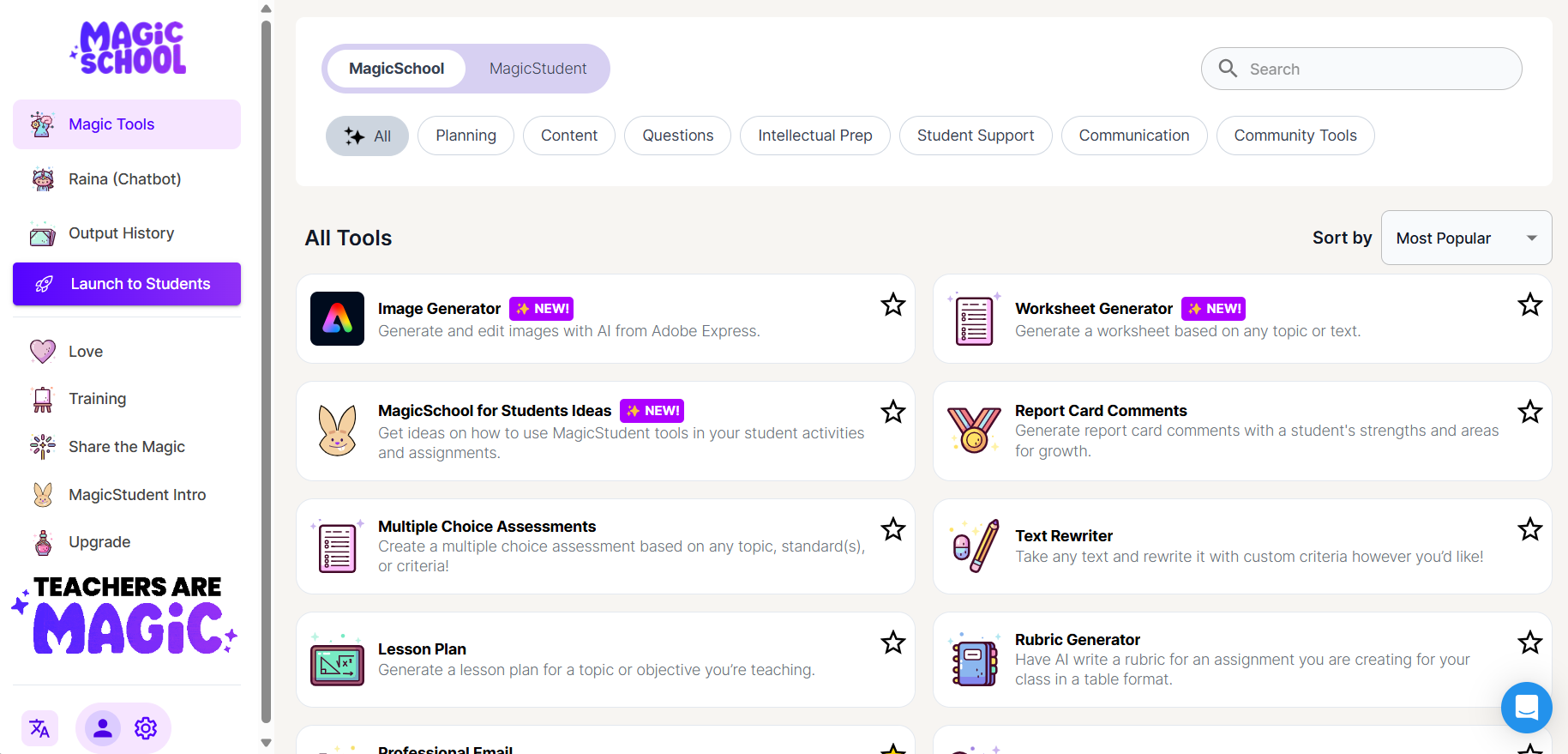
For educators to feel more comfortable having conversations about AI in the classroom, educators can start by using tools that help the educator in the planning phase. For educators, “AI can be used for task automation, administrative work, analyzing learning patterns, grading homework, responding to general queries, and various other educational processes” (2023). Two beginner-friendly tools for educators are Khanmigo and Magicschool.AI. For educators who feel comfortable with AIs, Microsoft Copilot is being streamlined into all Microsoft apps. Finally, Grammarly is the first AI I use in the classroom, and I ensure all students leave my class with an account. Once the educator feels comfortable with the tools, these tools can be used to help create a blended classroom environment.
Khanmigo
Khanmigo is Sal Khan’s addition to the AI world specifically for education. It has 24 free action-specific tools for educators, which can then be categorized depending on what the educator tries to do. Whether differentiating, creating, or even learning something new, Sal Khan understood that educators might be new to the AI world. Khanmigo makes it easy for educators to integrate AI into their classrooms as the tools can also translate into student use as activities. Khanmigo is also an AI tutor for students who assist with problem-solving instead of simply giving students answers.

Magicschool.AI
Magicschool.AI is similar to Khanmigo because it integrates action-specific AIs into the platform for students and educators. The key difference is that Magicschool.AI has 60+ compared to Khanmigo’s 24; however, this is due to Magicschool.AI being a paid platform. The extra generators are worth it for educators who are more comfortable with the AI world.
Microsoft Copilot
Microsoft Copilot is a chatbot that can help educators who simply need to get their ideas flowing. If an educator has an idea but no one to speak to, they can begin by asking Copilot for a simple prompt. For example, “I would like to create a project for my 10th-grade English class using Kate Chopin’s The Story of an Hour; how can I make it historical?” Copilot will give responses along with clickable links to where it found its information, shown below by the numbers 3 and 1.

Grammarly
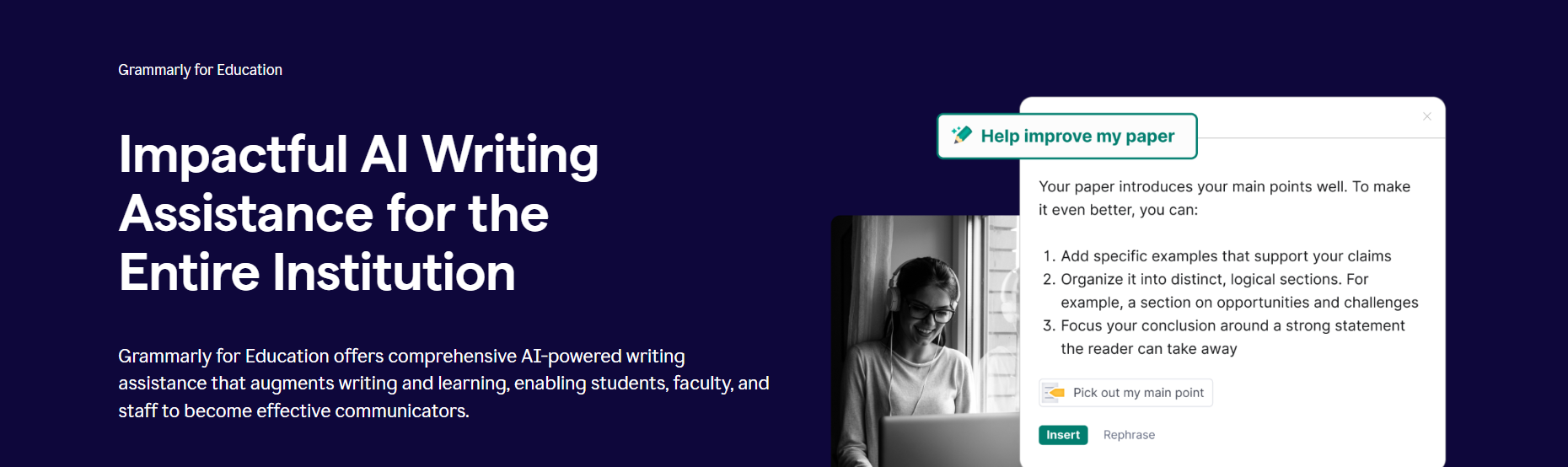
Grammarly is a grammar-based AI that I have used in my classroom for years. It is more thorough and explains why it suggests the change, so I use it instead of simply using the AIs built into students’ word processors. This creates an environment in which students are still responsible for reading the reasoning behind the suggestion and making the final decision about accepting or rejecting the change. Grammarly has been keeping up with the evolution of AI by integrating an education platform into its services that works for educational institutions.

AI-Based Cheating VS. the Flipped Classroom
Image created by Samara Marin Using Microsoft Copilot 2024
One of educators’ main concerns for allowing AI in their classrooms is students’ academic dishonesty. Educators who want to venture into AI integration for their classrooms could use the flipped classroom model to help combat cheating. Regarding the flipped classroom model, most, if not all, projects/assignments are done in the classroom while lectures are watched at home, replacing homework. If students are completing assignments that require them to show knowledge acquisition in class, this will defer any cheating attempts as the assignments are being completed with the educator present. This will also allow for discussions about AI use ethics during instructional time. If AI is presented as a tool for learning, they will use it that way. If it’s seen as a tool for cheating, they will use it for cheating.
There’s No Hiding From AI
Discussions about what is ethical when using AI are happening with or without educators involved. Students will use AI, whether for cheating or learning, depending on how they are taught. Additionally, educators avoid AI integration into their classrooms because they feel underprepared. However, for educators to feel more comfortable using AI, they first must learn how to use it. That being said, educators have other priorities throughout the year that they must complete. The unease about using AI in the classroom can be alleviated by professional development offered by administrators as a part of the mandatory workshop days.


How Do Educators Feel About AI?
Image created by Samara Marin Using Adobe Firefly 2024
I interviewed two of my classmates to discover how some of my classmates felt about the same topic. Both are currently educators in different grade levels and educational settings. Amongst the three of us, we cover elementary to high school, public, charter, and private schools. Maria teaches 1st through 8th grade Spanish at a private school. Amburh teaches all subjects for her 2nd-grade class in a public school, while I teach English in a charter high school.

References
Image created by Samara Marin using Adobe Firefly 2024
Adam Zewe | MIT News. (n.d.). Explained: Generative AI. MIT News | Massachusetts
Institute of Technology. https://news.mit.edu/2023/explained-generative-ai-1109
AI in education: How Artificial Intelligence is Impacting the Classroom. Computeam.
Artificial Intelligence. Lamar.edu. (n.d.).
Demir, B. (2023, August 17). How can AI tools be utilized to increase Classroom
Engagement? Twin Science. https://www.twinscience.com/en/teacher-tips/how-to-utilise-ai-tools-to-increase-classroom-engagement/
DeVille, K. (2024, May 10). How to Use AI for Teachers: Enhancing Classroom Learning.
STEM Education Guide. https://stemeducationguide.com/ai-for-teachers/
Embracing Artificial Intelligence in the Classroom. Harvard Graduate School of
Education.(n.d.).https://www.gse.harvard.edu/ideas/usable-knowledge/23/07/embracing-artificial-intelligence-classroom
Ethical AI for teaching and learning: Center for teaching innovation. Ethical AI for
Teaching and Learning | Center for Teaching Innovation. (n.d.).
https://teaching.cornell.edu/generative-artificial-intelligence/ethical-ai-teaching-a
d-learning
Free, AI-powered Teacher Assistant by Khan Academy. Khanmigo. (n.d.).
https://www.khanmigo.ai/teachers
Foote, K. D. (2024, March 5). A Brief History of Generative AI. DATAVERSITY.
Forbes Magazine. (2024, March 6). Artificial Intelligence in Education: Teachers’ Opinions
on AI in the Classroom. Forbes.
https://www.forbes.com/advisor/education/it-and-tech/artificial-intelligence-in-school/
Getting Started with Ai-Enhanced Teaching: A Practical Guide for Instructors. MIT Sloan
Teaching & Learning Technologies. (2024, May 6).
https://mitsloanedtech.mit.edu/ai/teach/getting-started/
Grammarly for Education. Grammarly. (n.d.). https://www.grammarly.com/edu
Kim, N. J., & Kim, M. K. (2022, February 22). Teacher’s Perceptions of Using an Artificial
Intelligence-Based Educational Tool for Scientific Writing. Frontiers.
https://www.frontiersin.org/journals/education/articles/10.3389/feduc.2022.755914/full
Parker, Dr. J. (2024, January 29). Educator Edtech Review: Magic school ai.
TechLearningMagazine.
https://www.techlearning.com/news/educator-edtech-review-magic-school-ai
Professional Writing Starts in the Classroom: Building Career Readiness Through
Communication. Grammarly. (2022, September 13).
https://www.grammarly.com/blog/building-career-readiness/
Sammour, G. (2023, October 19). A Practical Agenda for Using AI in the Classroom.
AACSB.
https://www.aacsb.edu/insights/articles/2023/05/a-practical-agenda-for-using-ai-in
the-classroom
Team, M. E. (2024, June 3). Meet your AI Assistant for Education: Microsoft Copilot.
Microsoft Education Blog.
https://www.microsoft.com/en-us/education/blog/2024/01/meet-your-ai-assistant-f
r-education-microsoft-copilot/
Walter, Y. (2024, February 26). Embracing the Future of Artificial Intelligence in the
Classroom: The Relevance of AI Literacy, Prompt Engineering, and Critical
Thinking in Modern Education – International Journal of Educational Technology in Higher Education. SpringerOpen. https://educationaltechnologyjournal.springeropen.com/articles/10.1186/s41239-024-00448-3
YouTube. (2023, May 1). How AI Could Save (Not Destroy) Education | Sal Khan | Ted.
YouTube. https://www.youtube.com/watch?v=hJP5GqnTrNo&t=481s


 Marin's Eportfolio
Leave a reply to 4DX Model: Implementing WIGs for Effective Organizational Change – Marin's Eportfolio Cancel reply