
Evolving Technology in the Classroom
Created using Dalle-3 by Samara Marin 2024
The first day of class in January 2024 I discovered that I would be working on a project for the entirety of the program. The more I looked into the assignment, the more confused I became. I was being asked to create an innovation plan to change some aspect of my organization. How was I supposed to change my organization? And more importantly how would I plan it?
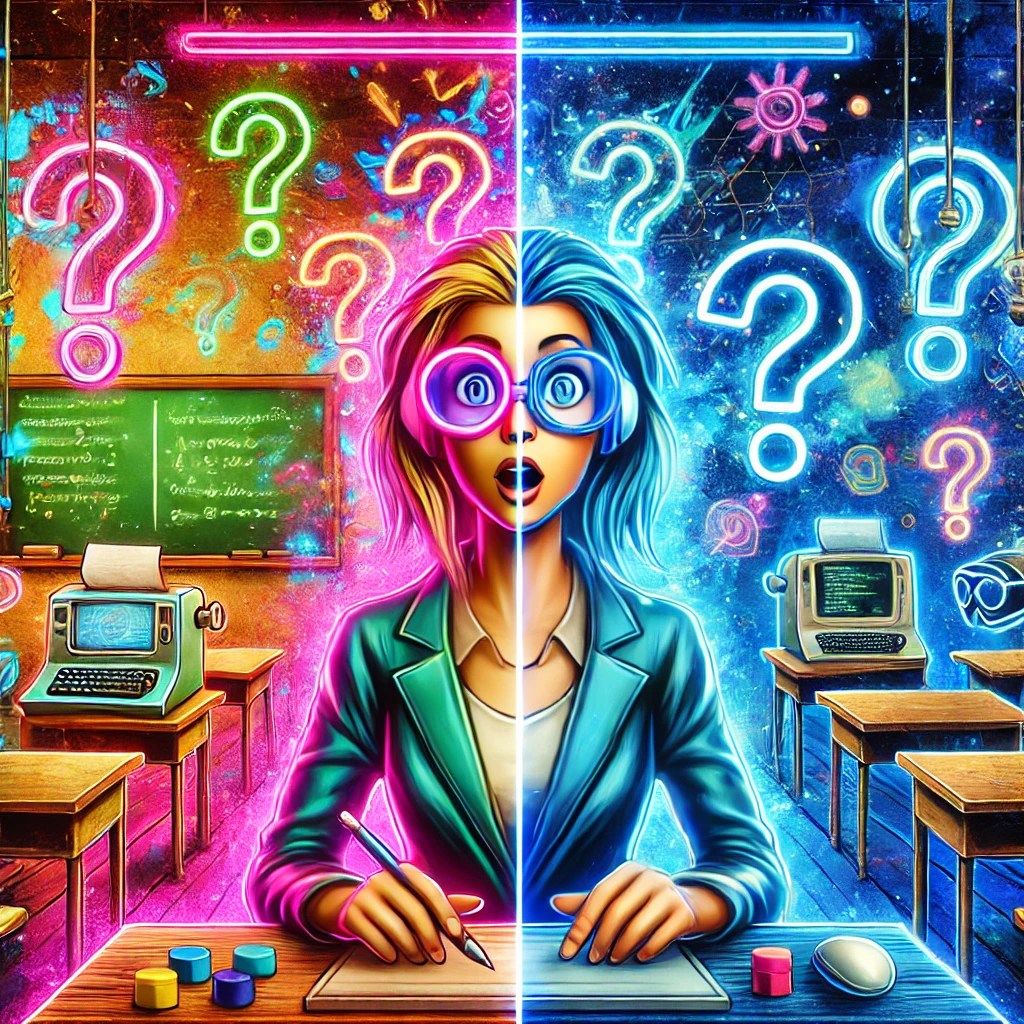
The first iteration of my innovation plan would be similar to a professional development video—a perfect-world version of what I hope to accomplish. Even though my original plan would take about two years to complete, it needed to state what resources educators would use to help plan and create content for the flipped classroom. As I went through the Applied Digital Learning (ADL) program, I began to realize what would actually go into creating a change environment in my organization. I was planning on instructors jumping to an entirely new program without thinking of the learning curve, what the professional learning environment would look like, or even what would be beneficial for our campus, which is already 1:1 with Chromebooks. Students in our district begin using iPads in elementary school, moving onto Chromebooks by the time they reach middle school.

Thinking back on what caused me to change my innovation plan I can think of four courses that fueled the change: Concepts of Educational Tech, Applying EdTech: ePortfolio, Resources in a Digital Environment, Leading Organizational Change, and Developing Professional Learning. Each class helped me see a different aspect of my original innovation plan that would not work. Below is a description of how each class helped change my innovation plan.

Concepts of EdTech: In this course, we read Mindset: The New Psychology of Success by Carol Dweck. Through this reading, I realized that I did not have a growth mindset most of the time. I could see that believing that I could not change was a product of my fixed mindset. The more I read the book, the more I realized that my doubts about causing change were caused by my fear of failure. Through this book, I began to focus on progress made during the journey instead of the end of the journey.
Applying Edtech: ePortfolio: In this course, I was able to recognize the benefits of an ePortfolio. Being able to explore through designing my ePortfolio, I became more accustomed to using AI as an assistant. I realized that AI is a tool that, if used correctly, can benefit students and teachers. However, I had to contemplate how ready educators are to incorporate AI into their planning as well as their classrooms. The more AI helped me, the more I wanted to show students that AI is a tool to learn and not cheat. I incorporated it in my innovation plan to help educators create lessons and assignments for their flipped classroom in an already busy schedule.


Resources in a Digital Environment: This course gave me the advantage of creating a publication of my choosing that could help bring my innovation project to life. I decided to research and write a publication about AI and the benefits of incorporating it in a flipped classroom setting. Through my research for my publication, I realized that the flipped classroom could help combat cheating and teach both students and educators how AI can be used ethically.
Leading Organizational Change: In this course, we read three books:
- The 4 Disciplines of Execution: Achieving Your Wildly Important Goals.
- Influencer: The New Science of Leading Change
- Crucial Conversations: Tools for Talking When Takes Are High
These three books helped me understand that quick fixes will not last long. I understood that simply because the change was happening slowly it didn’t mean it wasn’t impacting those around me. I started by changing a few coworkers’ minds through showing them AI resources that could help them. By doing this I created small waves of interest in AI resources which led to being given the opportunity to present a Professional learning over AI resources for the classroom.


Developing Professional Learning: In this course I was able to take everything I have been researching for my innovation plan, and create a professional learning plan for my organization. I was then given the opportunity to present this professional learning to my campus so teachers can see the benefits of AI when it comes to planning. Due to the constructivist learning theories, I came to terms that I would first have to teach educators in my organization the different uses of AI before I could expect them to implement them when flipping their classroom.
Images in table created using Dalle-3 by Samara Marin 2024

Where Am I Now?
Created using Dalle-3 by Samara Marin 2024
The more I work on my innovation project, the more strongly I feel that I need to see it through. For this to happen, I need to tackle any negative ideas that may come with a complete overhaul of how classrooms have been run. Through the Leading Organizational Change course, I created a plan that would help keep educators in my organization from being dragged into the whirlwind of daily life as a teacher. Through my reading, I learned how to incorporate effective communication with my fellow educators and the 4DX model into my plan in order to ensure that my wildly important goals (WIG) are reached. I realized that while I knew what I wanted to incorporate, I had to listen to my fellow educators to see what perspective they had about my plan.

In my initial innovation plan, I find myself still in the preplanning stage because I decided to integrate a new element: incorporating organizational input. Through what I learned in my Organizational Leadership course, I realized that I didn’t have to develop my innovation plan on my own. Instead, I could use the influencer strategies to influence those around me, who would, in turn, influence others. I started by teaching a small group of coworkers about the capabilities of AI, specifically tailored to meet their classroom needs. By using my learning philosophy to identify what my fellow educators wanted to learn, I was able to create a professional learning plan aimed at demonstrating how to use AI to facilitate the flipping of classrooms. Through communication, I discovered that much of the resistance to flipping the classroom stemmed from a lack of planning time. New educators are often preoccupied with learning how the organization expects them to teach before they can consider modifying their lessons. Meanwhile, veteran educators tend to have most of their lessons and backup plans established due to years of experience in lesson modification. For many educators, it is easier to continue on the same path they are already following. To address these challenges, I compiled a list of AI tools that can assist educators in their planning processes, along with the benefits of using AI for this purpose, as part of my publication course.

By listening to my coworkers, I was able to evaluate what my specific organization needed. I also learned what kept many coworkers from flipping their classrooms or even incorporating AI into their prep and lessons. I realized that I had gone into my innovation plan with solely my perspective. I updated my plan to incorporate constructivist theories and a COVA mindset. The constructivist theories allowed me to meet all the learners within my plan at their level without leaving anyone behind or boring anyone. I did this by first asking for feedback about AI in general. What is an educator’s perception of AI? What do educators wish they could do with AI? What did educators need AI to help with to alleviate the time spent on lesson planning and incorporate the flipped classroom? While gaining feedback from most coworkers, I helped a select few become accustomed to AI assistants they were interested in. By showing a select few how to use AI, suddenly I am no longer the only one who can teach my organization. In addition, those who are already saving time in their prep are helping change the perception of AI from being a tool for cheating to being a tool for learning.

Upon reflecting on my experiences, I recognize that I would have prioritized improving my communication skills from the outset. As I planned discussions with my coworkers and classmates, I realized that my innovation plan needed to adapt and evolve to accommodate multiple educators, rather than just my own perspective. Initially, I tried to handle everything on my own, but as I learned through the principles of collaboration, that approach was destined to fail. Therefore, cultivating a growth mindset and fostering collaboration will be the key principles I incorporate into the execution of this innovation plan and all future initiatives.

Where Am I and Where Am I Going?
Created using Dalle-3 by Samara Marin 2024
Through my time in the ADL program, I have created and updated my innovation plan. The plan started working better once I realized that my plan was ever-evolving. Adopting the growth mindset taught me not to let setbacks keep me from completing my goals. With what I have learned in the ADL program, I will go into my next innovation plan with the tools to implement the plan and stick to the plan I create through all of the evolutions it will, without a doubt, go through. Through changing my perspective, I can see that those setbacks are the reason that my innovation plan was able to evolve. Simply because I was expecting a flower, I should not be disappointed in a tree; I could still grow and create something.


References
Created using Dalle-3 by Samara Marin 2024
Covey, S., McChesney, C., & Huling, J. (2012). The 4 Disciplines of Execution: Achieving Your Wildly Important Goals. Simon and Schuster.
Dweck, C. S. (2006). Mindset: The New Psychology of Success. New York, NY: Random House
Gulamhussein, A. (2013). Teaching the Teachers Effective Professional Development in an Era of High Stakes Accountability. Center for Public Education. Retrieved from http://www.centerforpubliceducation.org/system/files/2013-176_ProfessionalDevelopment.pdf
Harapnuik, D. & Thibodeaux, T. (2023). COVA: Inspire Learning Through Choice, Ownership, Voice, and Authentic Experiences. Learner’s Mindset Publishing
Patterson, K., & Grenny, J. (2013). Influencer: The New Science of Leading Change, Second Edition. McGraw-Hill Education.
Patterson, K., Grenny, J., & Swizler, A. (2012). Crucial conversations: Tools for Talking When Stakes are High. (2nd ed.). McGraw-Hill New York, NY.
Standards for Professional Learning: Quick Reference Guide. (2011). Retrieved from https://learningforward.org/docs/pdf/standardsreferenceguide.pdf?sfvrsn=0
Thomas, D., & Brown J. S. (2011). A New Culture of Learning: Cultivating the Imagination for a World of Constant Change. (Vol 219) Lexington, KY: CreateSpace.
Wiggins, G. P., & McTighe, J. (2005). Understanding by Design, Expanded 2nd Edition. Pearson.


 Marin's Eportfolio
Leave a reply to A Review of the Literature – Marin's Eportfolio Cancel reply